
TC or GTFO
An anthropology of online anonymity in an age of layoffs


My first job in tech was at a certain well-known job board. The vibes were great, the CEO genuinely valued progressive politics, and it was the era of bringing your whole self to work. Employees used to say that the company would never have layoffs, believing that it was antithetical to the mission and values, and would also yield terrible optics. “Leadership cares about us and wouldn’t do that.” I had my doubts.
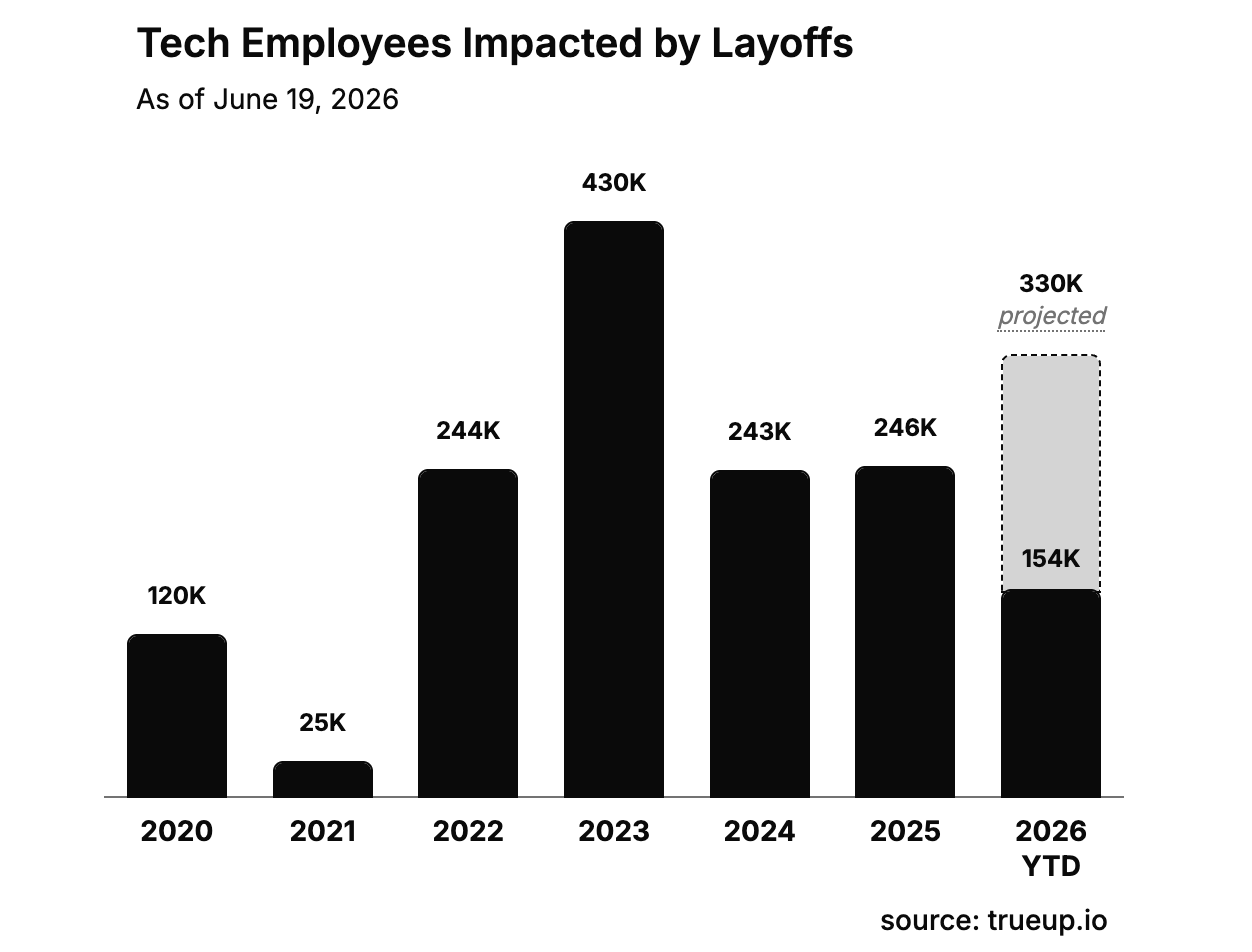
Fast-forward a few years and, like virtually every tech company out there, that one has faced multiple rounds of layoffs. The numbers speak for themselves: an estimated 150,000 tech workers have been laid off already this year, building on the momentum of over 245,000 tech job losses in 2025. Are the halcyon days of tech over or are we just seeing a shift toward business as usual, with workers as collateral damage? Either way, it’s a reality check after an era of workplace wellbeing, girlbosses, greenwashing, and cash to burn.
Responding to ongoing layoffs, one tech worker recently cautioned: “This is exactly why you should ‘never’ sacrifice too much for these companies. You are always disposable to them.”
I pulled this quote from a recent New York Times article, which in turn pulled it from Blind, an app for anonymous shop talk among tech workers. The piece explored how techies’ morale continues to plunge amidst ongoing industry turbulence, AI, and the most employer-friendly job market in a decade, examining how workers use Blind to share information, predict layoffs, compare severance packages, and commiserate.
I was intrigued by the portrayal of Blind as a Robin Hood-infused whisper network for tech employees as they navigate ongoing precarity. This framing pulled at the heartstrings, sure. It also obscured the reality that Blind is, to quote one NYT reader comment, “essentially 4chan with a corporate email gate.” But could both be true?
Anthropology claims to “make the familiar strange,” but I’ve always thought one of its biggest strengths lies in making the shocking or even abhorrent intelligible. In that spirit, I began to see Blind as a rich ethnographic playground — a cultural artifact offering an unfiltered window into the worries, belief systems, and dirty underbelly of tech, as well as the ambivalence of many people who are just trying to get by.
So I took a closer look.
Onboarding lessons
Blind was part of my unofficial onboarding during week one of my first tech job. In anthropological terms, onboarding is a ritual designed to transform outsiders into insiders. As a new hire, I attended my three-hour training session on day one, got my company tshirt, met my manager for lunch, and then received a deck mapping out the next few months of my work life. I was told how my skills and responsibilities would develop in 30, 60, and 90 days. I got a list of resources, including what SaaS tools to use for which granular tasks. I found out that my new employer offered pet insurance, along with the human kind. And, most importantly, I received a list of around a dozen colleagues to meet with individually in 1:1s (a term I also learned that day).
These meetings socialized me into the language and norms of the company more than any proper training session. Some colleagues were buttoned up, others asked me rapid fire questions about my background and goals. One, I distinctly recall, told me that the first thing I needed to do was get on an app called Blind. This would give me the real lay of the land.
The process was simple enough. I downloaded the app, signed up with my corporate email for verification purposes, and then received an anonymous username which I used to access a world of anonymous posts from fellow tech workers. In Blind, I could see open posts from random people or else click on my company to read posts exclusively (in theory) from current employees. These were the boom days of tech, so there was only so much to see. Gripes about new or outgoing leaders, perhaps, or the occasional HR scandal.
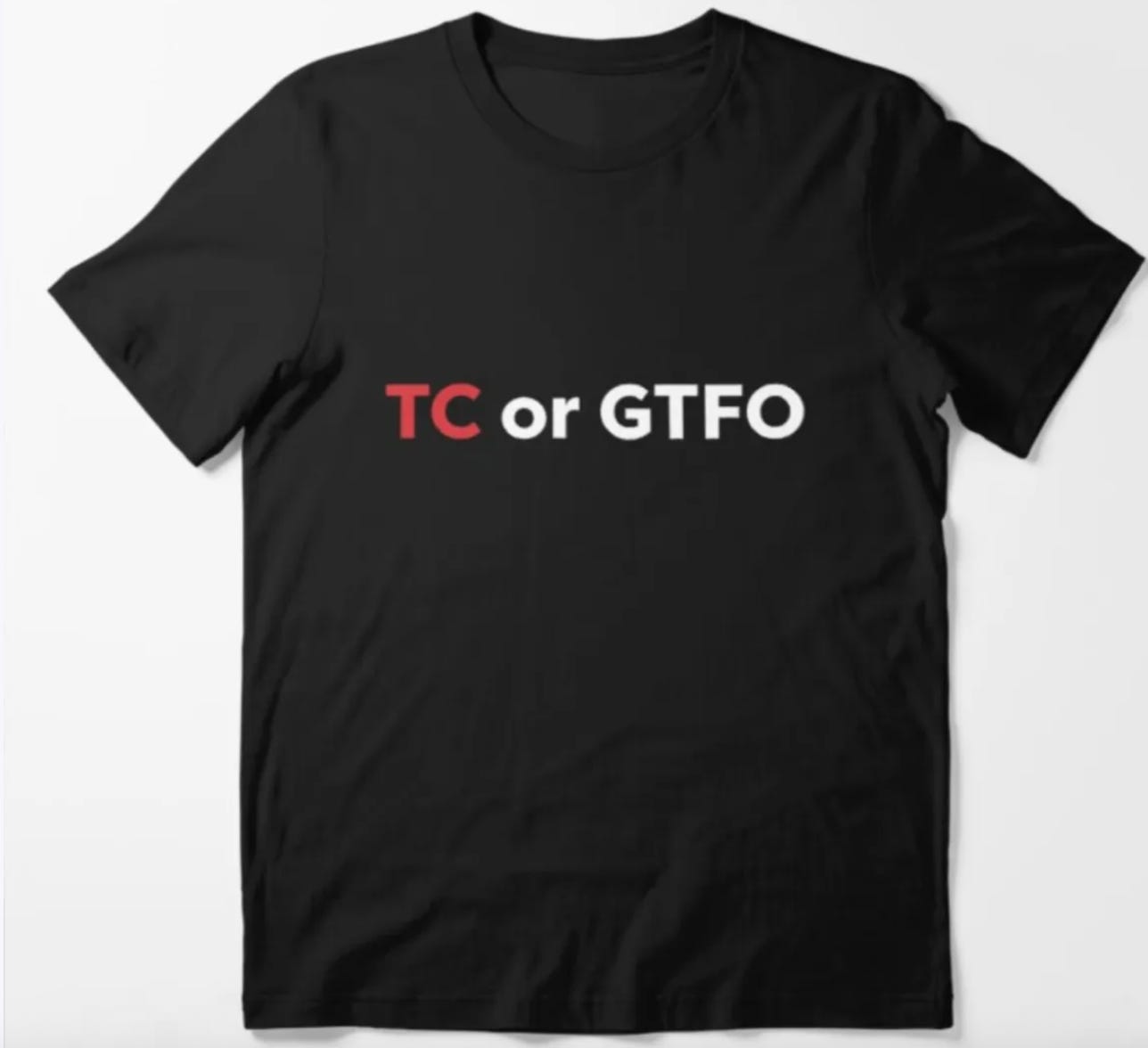
As a woman and anthropologist who’s been on Blind for over seven years, I was intrigued by the feel good portrayal in the NYT. The article didn’t even mention the trademark ultimatum for posts: TC or GTFO, short for “total compensation or get the f%$* out.” Or the fact that the comp listed by even the most anxious Blind users is often in the multiple six figures at a time when 67% of Americans are actively stressed about money.
Indeed, I’d long ago dismissed Blind as an entitled, male-dominated space. The internet troll vibes loom large, from sexist rants about which cities have the “hottest girls” or crowdsourcing feedback on whether someone’s wife is cheating. There are anti-H1B tirades, remarks that anyone over 40 is unemployable, and thirty-somethings comparing net worths well into the millions.
But if that was all it offered, why were so many people still lurking? Why was I?
Dissertation déjà-vu
An anthropologist’s role is to suspend judgment, even (or especially) when it feels impossible. Do I think Blind is a festering stew of capitalism, corporate anxiety, and the broligarchy? Sure, but it’s not that simple. It’s also a space where workers in a rapidly changing industry can gain insight into the darker side of their work life — things like disappearing team members targeted by stealth layoffs, vastly unequal pay packages, gut checking fears about company instability, or, of course, trading inside intel on layoffs.
To my surprise, digging deeper into Blind’s post made me think back to my dissertation research on digital community building.
Beginning in 2010, I conducted a multi-year study on how ideas about visible, but undiagnosed or extremely rare, disabilities were shifting due to a combination of rising awareness, genetics innovations, and the internet — particularly social media. The last point sounds somewhat dated today, but was a lifeline to many families I met.
For many, connecting with others navigating similar situations provided key emotional and logistical support they could not get otherwise. In some cases, parents even solved their child’s medical mystery, securing a diagnosis to a one in a million syndrome after connecting with others who had similar symptoms or features. More typically, they got recommendations for medical or genetics experts, learned about niche organizations dedicated to rare conditions, or simply met others grappling with diagnostic ambiguity.
My research in this space was in the good old days. It was before Elon bought Twitter and Meta helped sway elections, before deepfakes and AI slop, before the stinky swamp of online commenters, grifters, bots, and scams. It wasn’t quite a utopian time, but one could imagine the cup being half full. The families I studied needed information on an existential level, but they yearned for something else: belonging and community, which they found online, sometimes for the first time.
Thanks to these digital spaces, they were able to connect, communicate, and feel heard in ways that felt impossible otherwise.
It was before Elon bought Twitter and Meta helped sway elections, before deepfakes and AI slop, before the stinky swamp of online commenters, grifters, bots, and scams. It wasn’t quite a utopian time, but one could imagine the cup being half full.
Social creatures, social connections
People can weather tremendous challenges on their own, yet still crave a community that understands them. At the same time, we are hardwired to assess our environment continuously, take in data about what could jeopardize or improve our current state, and act accordingly. These are the roots of innovation and technology, and it’s also why we are herd animals — not out of laziness or a lack of imagination, but as a strategy for protection, survival, and adaptation in an unpredictable world.
Information sharing plays a tremendous role in this process and includes gossip, a powerful social glue. In today’s digitally disjointed world, people come together daily to trade information and misinformation about health, politics, relationships, childrearing, you name it. You don’t have to take my word for it: Reddit’s market cap is over $33 billion and the company is little more than a bulletin board for people seeking answers or trading opinions. This is also why, despite rolling my eyes at Blind, I still find myself peeking at posts alongside 10 million fellow users.
The ongoing job losses have created a new community of sorts, with approximately 400,000 people laid off in the last year and a half. This is a huge huge pool of professionals navigating a similar experience, on top of the others who are still employed and increasingly nervous. I suspect the real number is higher, since official figures likely don’t include more targeted “stealth layoffs” that are often masked as performance issues or reorgs. Nearly everyone I know in tech feels the tension.
But losing a job is not only about salary or perks, particularly for highly paid workers with resources, networks, and, of course, severance packages. Work plays a tremendous role in our daily lives, shaping everything from economic stability to a sense of self. It gives us daily uniforms, rituals, jargon, and friends, structuring our days in ways that are both visible and intangible. And the social bonds we experience at work play a huge role in how we feel on and off the clock.
As with any relationship, building connections and sharing information requires open communication and an element of trust — both of which are harder than in the past, since our interactions are increasingly mediated by tools. Despite the many logistical benefits of remote work, research indicates that these mediated connections differ qualitatively from face-to-face; we are wired for the latter form, but rely increasingly on our screens. I’m sure I’m not the only person who’s commuted to an office only to have video calls with other people in the same building. And don’t get me started on Slack.
I’m sure I’m not the only person who’s commuted to an office only to have video calls with other people in the same building.
For all the talk about mythical “water cooler conversations” as a catalyst for productivity and innovation, there’s noticeably less attention paid to how hard it is for today’s workers to build genuine social bonds. Many of us come together in open offices, where even meeting rooms can have iffy soundproofing. Catered onsite lunches make it hard to tuck away for a quiet conversation. We have faster, superficial, and indirect access to more people than ever, yet the quality and tone of the interactions is fundamentally different.
This is where Blind comes in.
Reality bites
That which frees us in some ways constrains us in others.
A grad school prof said this casually in a theory seminar one fall semester and I still repeat it all the time.
Blind’s shortcomings aren’t subtle, and posts often feel more like an SNL skit about toxic masculinity than anything remotely work-oriented. Some recent examples include a one titled “Lack of sex in marriage,” which netted over 220 responses in less than a week. The advice ranged from “Feed her cow broth, she will get back her libido in no time” to “Start smashing college girls, they love tech money.”
Then there were the posts from Blind users responding to the NYT article. “Bunch of losers with schadenfreude in the NYT comments,” said one, echoing the common refrain that anyone who dislikes big tech is jealous. “We all have to start getting our mixologist degrees,” said someone else.
But another recent post asked what users would do when, not if, they got laid off. “I’d like to get a simple $90K job…so I can spend time with my kids after school, that pays for health insurance and offers a 401K, and does not force me to use AI.” Another commenter wrote: “Probably teach (my dream).”
Nestled between dubious posts about living paycheck-to-paycheck while banking $600K annually were polls gauging whether coworkers felt ominous in the air. Others simply said they were “milking it while it lasts” and cautioned fellow anonymous users to not take work too seriously, have a backup plan, and understand that the perceived security of the recent past is gone — at least, for now. These are precisely the types of guidance that are harder to share without anonymity, and downright risky in most tech offices.
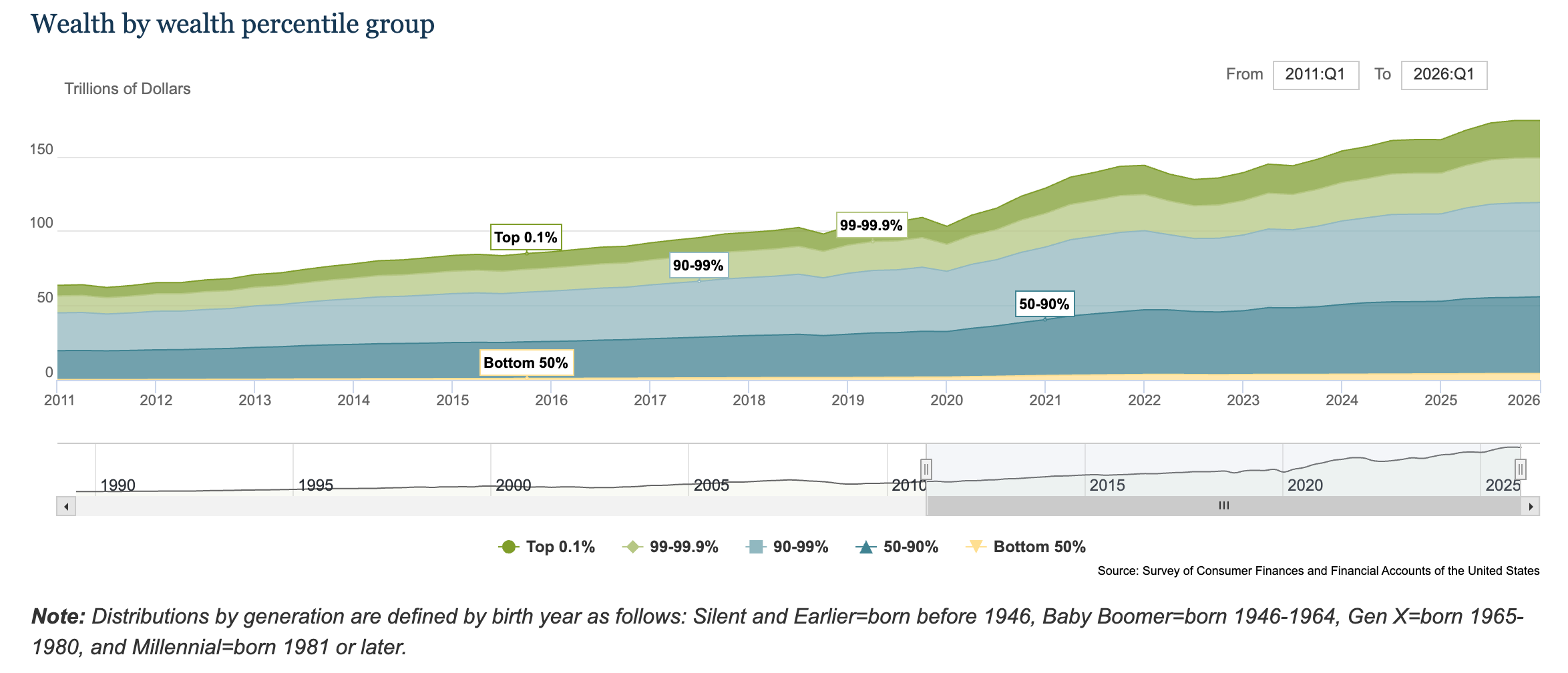
These sentiments coincide with an interesting shift in our broader cultural moment. Tech money and power have shown themselves to be much like other forms of money and power. The political climate is tenuous at best. Waves of Gen X nostalgia are everywhere from the soapy romance Off Campus, which references Dirty Dancing and Rent, to young people lashing out at Millennials’ stereotypically try-hard attitudes mid-century modern, succulent loving aesthetics. All of this coincides with rising inequality in the US. The top 1% now holds over $50T of wealth today, a threefold increase from 15 years ago.
In spaces like Blind, we find competing and discordant forces. There are the MAGA-sounding, money-loving, crypto-schilling bro types. There are racist, xenophobic, and sexist diatribes that are the stuff of thick HR files. There are demands for “TC or GTFO” and posts asking if $11M net worth is enough to retire before 40.
But, simultaneously, there are efforts to prepare for and predict layoffs, which toss workers aside amidst rising profits, speculative product development, and the ongoing crush to get AI right, whatever that means. There are posts asking if you can, in fact, negotiate a severance offer or hire an employment attorney. Or what to do if you suspect you’re being put out to pasture or getting PIPed after parental leave. When to jump ship versus stand your ground. And whether tech is the right path at all, if such a thing exists.
Webs of meaning
Sociologist Max Weber wrote that humans are “suspended in webs of significance.” We created these webs and they structure our lives and worlds, yet they do not exist outside of or without us. Not so coincidentally, Weber also literally wrote the book on the religious underpinnings of the capitalist work ethic.
Work keeps us busy and active, fills our days and structures our weeks; it provides tasks to keep the brain engaged, money to put food on the table, and connections to scratch our deep social needs.
I go back to the webs of significance again and again. The key idea is that we live in a world that we have created. We exist within these social constructions, but they still matter. The ideas, institutions, and methods of organizing society are creations, yet they are real. They are arbitrary products of history and culture, but they are ours. The trick is to understand them as such — not as natural elements, but as having distinctly human origins — while still taking them seriously.
Work is a powerful example. It organizes our societies and provides livelihoods. It is how we make the things that we need, want, and perhaps later discard. Work keeps us busy and active, fills our days and structures our weeks; it provides tasks to keep the brain engaged, money to put food on the table, and connections to scratch our deep social needs.
This is a transitional moment and I don’t just mean because of AI, although that’s part of it. Many of my professor friends are struggling with student AI usage alongside restricted academic freedom. Politics has a larger hand in scholarly and scientific research than at any point in my lifetime. Yet as headlines tout the renewed value of the humanities and social sciences, these disciplines are under attack.
At the same time, morale among tech workers — the sector that dominated my work life and fundamentally reorganized the city where I live — has never been lower. Some are voicing this publicly. In the last week alone, I’ve seen multiple posts on LinkedIn from tech professionals lamenting the prevailing sense of burnout, uncertainty, and a lack of direction beyond all things AI. Just this week, that politically engaged CEO from my first tech job announced that he saw AI as the civil rights struggle of our time and is now working to fight the AI lobby’s role in US elections.
But for others, anonymity is a lifeline. It enables them to say what might feel unsayable and gauge whether their feelings or worries are valid. It’s an opportunity to ask what might be different or better, or lament that seeming like they “have it all” might not feel as good as they thought. And it carves out space for imagination.
To that end, I think of political historian Benedict Anderson’s concept of “imagined communities.” Writing on the rise of nationalism, he explained how print journalism helped usher in an era of imagined shared identities, or horizontal kinship, by members of a group who would never meeting in person. Although Anderson focused on countries and nation-based belonging, it’s interesting to apply shades of his thinking to contemporary work, where affiliation with a particular company or sector often spans geopolitical borders. Rather than printed newspapers, we now rely on digital spaces like LinkedIn and Blind to create those shared identities.
What we see now is that, amidst widespread political, economic, and cultural shifts, those identities are in flux. Yes, Blind in particular and social media in general are fraught, generating a slew of problems for everything from public health to politics, mental health, and, of course, work.
But there’s more to the story. The paths that felt secure are not anymore. The companies that pretended to be different and better are not. “Corporate’s gonna corporate,” but what does that mean for workers who no longer want to play ball?
More and more people are thinking this way. More are trying to work it out, map their next moves, and ask what else might be possible.
And, anonymously or otherwise, they’re coming together.
I love this post and the way you weave academic findings with lived experiences. My book, Trust Fall: How Workplace Relationships Fail Us, pulls on many of these same threads from the angle of sociology. You might be interested, but even if not, really enjoyed this post.